Post
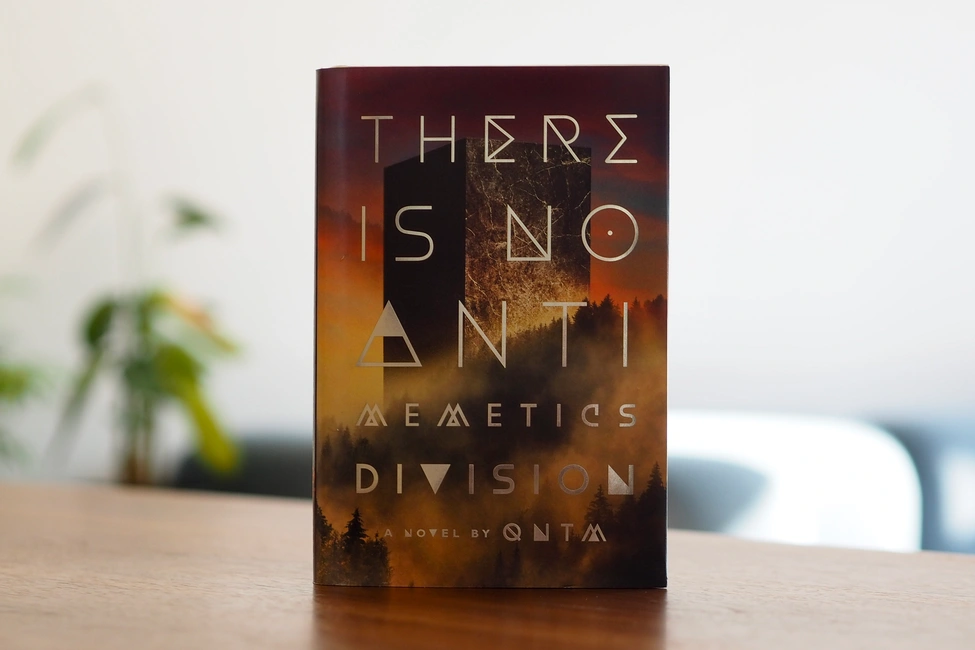
There Is No Antimemetics Division — A Book Report
May 5, 2026 · 7 minute read
A book about dangerous ideas
Rating
Rating: 3.5 / 5 The premise is a 5. The execution is a 3. I split the difference and rounded toward the bravery of the attempt.
Why this book
I bought There Is No Antimemetics Division by qntm while preparing for a flight, somewhere between adding socks to the suitcase and remembering I needed to charge my iPad that I wasn't going to use anyway.
I'd seen the premise written up somewhere — I can't remember where, which is quite funny and on the nose given the subject — and I read enough of the description to know I'd want a copy of it in my bag for the trip to Arizona. I'd have at least one airplane's worth of uninterrupted reading time, and twelve days to casually read it while in town, but then I dug into the first couple of chapters at home the day before we flew out, and then I put down the most considerable amount of it on the plane between the snack cart's first pass and a vague awareness that we were almost done flying over New Mexico. 3/4 of the book just flew by (pun intended).
I finished the last little bit solaced in the morning and alone poolside, the desert already warming up around me. There's something about closing a book in a quiet hour that makes the experience feel earned, offering time to reflect on the read. I closed this one and sat with it for a few minutes.
What the book is doing
Meme noun ('mēm) An idea, behavior, style, or usage that spreads from person to person within a culture
Memetics adjective (mē-ˈme-tiks) The theoretical study of how cultural ideas, beliefs, and behaviors replicate, spread, and evolve through populations via imitation
The premise is the real thing here. It offers the idea of an antimeme which is an idea that resists being thought about, remembered, or transmitted, almost as if it were an entity — and the anthesis to that being an agency responsible for cataloging the and containing the dangerous ones. The horror, when it lands, is conceptual rather than physical. Looking at it means it sees you. Thinking about it is contact. You can't strategize against an enemy you can't reliably hold in your head, and you can't warn anyone about a thing that erases itself from the warning the moment it arrives. That's a terrific idea.
That is the idea, and the parts of the book that sit inside it the longest are the parts where it sings.
The early chapters with Marion Wheeler do this beautifully. The bureaucratic-competence-porn texture — agents leaving notes for their future selves, reasoning around their own unreliable memory, strategically erasing themselves to escape something that hunts via attention — is some of the most original genre work I've read in a while.
The lake scene where Marie Quinn describes being inside the containment unit with this thing was the moment I sat up. The old agent shifting into the monster, the jump out the window, the way the threat is described as something that uses the act of perception against you — that had real weight. It also got conveniently overlooked later, which I'll get to.
Where it loses me
The honest version of my problem with this book is a craft one, and it's worth naming directly: it's a showing-versus-telling problem.
The book tells you the protagonist's marriage is strong. It tells you the threat is everywhere. It tells you the resolution matters. At each of those moments, what it needed to do was show you, and the parts that don't get shown are exactly the parts the climax is balanced on.
The Marion-and-Adam (protagonist's marriage) relationship is the clearest example. Their bond is load-bearing for the ending — her certainty that he'd come through is the thing that makes the meme-nuke real, the thing that makes the climax mean anything, but we're asked to take that certainty on faith. We don't really get to live inside the marriage. We don't see the small moments that built it, the texture that made her sure. We're told it's the kind of thing strong enough to hold a universe together, and then asked to feel it land. I wanted to feel it. I felt the idea of it instead... come to think of it, perhaps that was intentional?
The third act has a related problem. The antagonist — built up across the early chapters as all-pervasive, conceptually inescapable, dangerous because thinking about it is contact — gets demoted into something able to be fought in a physical sense. By the end it's effectively a creature feature, with arachnid-ish bodies and a hero who can engage them on their terms. qntm has talked about this on his site, basically saying he could explain the spider-monsters as part of Earth's antimemetic biosphere that the antagonist co-opted, but didn't because it would eat word count. That's a fair craft answer, and I understand it. It also confirms the trade I felt while reading: conceptual horror swapped for set-piece horror. When the unkillable becomes punchable, the premise has lost its original teeth. It's a very different kind of scary, and it's a kind the book had already promised wouldn't be the kind you got. Still, very entertaining.
The whole resolution has a faintly predeterminist vibe. Things don't go where I expected — the book is not predictable — but the climax arrives soft, more handed-over than fought-for. The epilogue almost reads like an apology for that, a clever symbiosis nod meant to give closure the main story didn't quite earn. I closed the book impressed by what it had tried, a little hollow about how it had landed. Again, very entertaining even still.
The frame I keep landing on
Reading around afterward, I found that a lot of the structural issues trace back to how the book exists in the first place. It started as stitched-together SCP shorts, then a self-published collection, and now this Random House rewrite. Multiple reviewers have flagged that it sits in an awkward middle — over-stretched in some places and under-developed in others — and would have been a sharper book either way. Tighter as a thought-experiment piece, longer as a novel with room to live inside its characters. Even the warmest reviews concede that the people in this book are quick sketches, and that deep characterization wasn't really the priority. That tracks with my experience. The world is rich. The premise is rare. The people are functions.
What it's doing right
The big-name praise is real and I'm not going to wave it off as it's high from great sources such as Blake Crouch, M.R. Carey, the Guardian, Locus — all of them in the cosmic-horror-classic camp. The most defensible version of that praise, to me, is the one that frames the book as something trying — a piece reaching for an idea so unusual that the reach itself is the achievement. That's a generous frame and also a true one. I'd rather read an ambitious near-miss than a polished retread of a story I've already read three times. There Is No Antimemetics Division is, at minimum, a near-miss in a direction nobody else is walking.
Verdict
I liked it and I'm glad I read it and I'd hand it to the right person tomorrow. I'd even watch the movie if such a metamorphosis occured.
I also think it's a book about an extraordinary idea that doesn't fully trust itself with the idea. The early chapters earn the conceptual horror. The later chapters spend it. The marriage is structurally critical and emotionally underwritten. The ending arrives without the weight the premise paid for. None of that makes it a bad book — it makes it a fascinating one with a few seams I can see.
If you like cosmic horror, weird epistemology, or stories that take memory and attention seriously as things you can do violence to — pick it up. If you need character work to carry a climax, you'll feel the same gap I felt.
I'll keep recommending it with caveats. Someone has to.
If you want to know when I post something new, drop your email below. No spam — just a heads up when there's a new post.